When Nature Went Nuclear: The Ohio Tree That Exploded Its Way Into Legal History
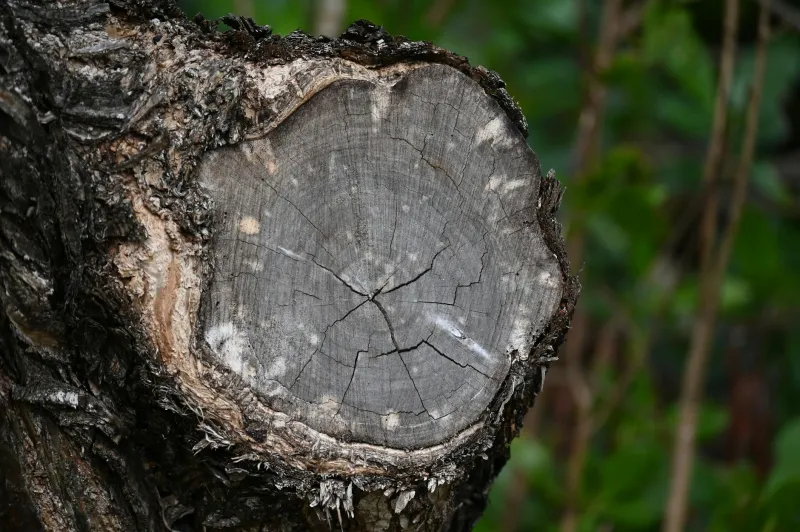
The Day a Tree Became a Weapon
Picture this: you're enjoying a quiet afternoon in 1856 Ohio when suddenly the massive cottonwood in your neighbor's yard explodes like a cannon, sending chunks of wood crashing through your barn roof, your fence, and your prize-winning pumpkin patch. Sounds like something out of a tall tale, right? Tell that to the residents of Hancock County, Ohio, who witnessed exactly this botanical catastrophe on a seemingly ordinary September afternoon.
The culprit was a 200-year-old cottonwood tree that had been slowly building up internal gas pressure for months. Unknown to anyone at the time, the tree had developed a rare condition where bacterial fermentation inside its trunk created methane and other gases faster than they could escape through the bark. When the pressure finally exceeded what the wood could contain, the entire tree detonated with the force of several sticks of dynamite.
The Aftermath That Lawyers Dream About
The explosion was spectacular in the worst possible way. Chunks of trunk, some weighing over 100 pounds, sailed through the air like medieval catapult stones. The largest piece crashed through the roof of Samuel Morrison's barn, killing three chickens and destroying a month's worth of grain storage. Another fragment demolished a section of fence belonging to the Hendricks family, allowing their prize bull to escape and terrorize the neighborhood for two days. A third piece landed squarely in the middle of widow Martha Crenshaw's vegetable garden, creating a crater that locals compared to a meteor strike.
But here's where things get really interesting: nobody could agree on who was responsible. The tree belonged to German immigrant Hans Mueller, who insisted he had no idea trees could explode and therefore couldn't be held liable for an "act of God." His neighbors disagreed, arguing that Mueller should have noticed something was wrong with his obviously diseased tree.
The Legal Circus Begins
What followed was one of the most bizarre court cases in American legal history. Mueller vs. Morrison, Hendricks, and Crenshaw became a three-ring circus that attracted lawyers from as far away as Cincinnati. The central question seemed simple enough: when a tree on your property spontaneously explodes and damages your neighbors' land, who pays?
The answer, it turned out, was anything but simple.
The prosecution argued that property owners have a duty to maintain their trees in a safe condition. The defense countered that nobody in 1856 America had ever heard of an exploding tree, making it impossible for Mueller to have prevented something that defied all known botanical science. Expert witnesses were called in from agricultural colleges, each offering increasingly creative theories about tree explosion mechanics.
The most memorable testimony came from Dr. Ezra Whitman, a professor of natural philosophy from Ohio University, who attempted to recreate the explosion using a small cottonwood branch and a bellows system. His courtroom demonstration went about as well as you'd expect – the branch didn't explode, but it did emit such a foul smell that the judge cleared the courtroom for the rest of the afternoon.
The Ruling That Changed Everything
After six months of legal wrangling, Judge Cornelius Bradford delivered a verdict that seemed to satisfy no one while simultaneously creating legal precedent that endures today. He ruled that Mueller was indeed liable for the damage caused by his tree, but only because he had been warned by neighbors that the tree "seemed unwell" and had failed to investigate further.
More importantly, Judge Bradford established what became known as the "Reasonable Foreseeability Doctrine" – the principle that property owners can be held responsible for damage caused by their property only if a reasonable person could have foreseen the potential for harm. This ruling became the foundation for countless property damage cases over the next 150 years.
The Science Behind the Spectacle
Modern botanists now understand that exploding trees, while rare, are a real phenomenon. They typically occur when bacterial infections create gas buildup inside the trunk faster than it can escape through natural pores in the bark. The process is similar to how a balloon pops when overinflated, except the "balloon" is a 200-year-old tree and the "pop" can be heard for miles.
Interestingly, cottonwoods are particularly susceptible to this condition because their rapid growth often creates internal cavities perfect for gas accumulation. The Ohio explosion wasn't even the last recorded case – similar incidents occurred in Kansas (1923), Oregon (1967), and most recently in Alabama (2019).
A Legacy Written in Lawbooks
Today, the Mueller case is still cited in property law textbooks and court decisions across the United States. Every time a tree falls on a neighbor's house, every time a property owner faces liability for something seemingly beyond their control, lawyers invoke the precedent set by that long-ago exploding cottonwood in Ohio.
The original courthouse where the case was tried still stands in Findlay, Ohio, complete with a historical marker that reads: "Site of Mueller vs. Morrison et al., 1856 – The Exploding Tree Case That Shaped American Property Law." Tourists occasionally stop by, though most assume the marker is some kind of local joke.
 Photo: Findlay, Ohio, via img.freepik.com
Hans Mueller, for his part, paid the damages and moved to California, where he reportedly planted only fruit trees for the rest of his life. The crater in Martha Crenshaw's garden eventually became a small pond that local children used for swimming well into the 1930s.
Sometimes the most profound changes in American law come not from constitutional conventions or Supreme Court decisions, but from the simple fact that nature occasionally behaves in ways that nobody saw coming. In this case, quite literally explosive ways.