Twice Cursed: The Steamship That Refused to Stay Above Water
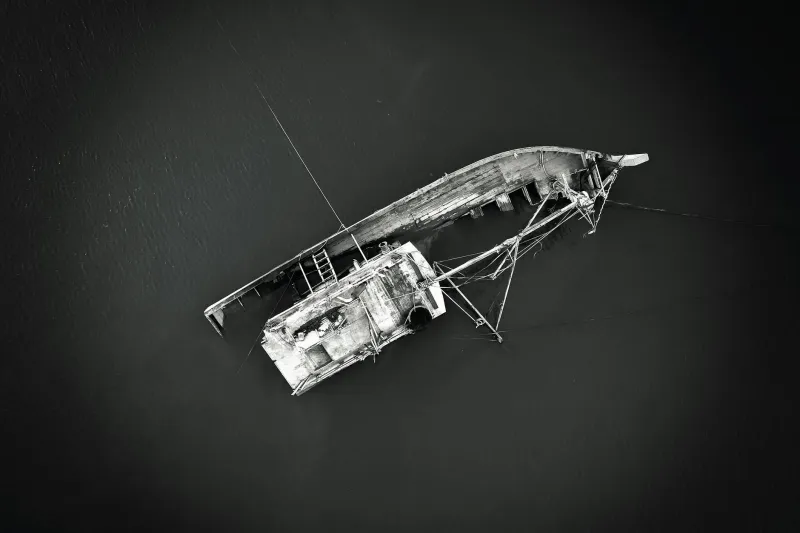
When Lightning Strikes the Same Ship Twice
Most ships that sink become footnotes in maritime history, remembered briefly before fading into the depths of forgotten disasters. But the SS Cambronne achieved something far more remarkable—and far more ominous. This French steamship managed to sink not once, but twice, earning a reputation as perhaps the most persistently unlucky vessel ever to challenge the Atlantic Ocean.
The story begins in 1923, when the Cambronne was considered a triumph of French shipbuilding. At 4,500 tons, she wasn't the largest passenger steamer of her era, but she represented the kind of reliable, mid-sized vessel that formed the backbone of transatlantic commerce. Built for the Compagnie Générale Transatlantique, she was designed to carry passengers and cargo between French ports and destinations across the Atlantic with the dependability that made ocean travel routine rather than adventurous.
For nearly a decade, the Cambronne lived up to those expectations, making regular crossings without incident. Passengers praised her stability in rough seas, and shipping companies appreciated her consistent scheduling. By all accounts, she was exactly the kind of unremarkable, reliable vessel that maritime commerce depended upon.
The First Dance with Disaster
On March 15, 1932, the Cambronne's luck ran out spectacularly. While en route from Le Havre to New York with 127 passengers and a cargo hold full of French wine and luxury goods, the ship encountered a storm system that meteorologists would later describe as "unusually severe for the season." What started as rough weather quickly escalated into a maritime nightmare.
 Photo: Le Havre, via i.pinimg.com
The official inquiry never determined exactly what caused the catastrophic hull breach that sent the Cambronne to the bottom of the Atlantic in less than four hours. Some witnesses reported hearing an explosion from the engine room, while others insisted the ship simply cracked apart under the stress of massive waves. What everyone agreed on was that the vessel went down with shocking speed, taking 23 lives and cargo worth nearly $2 million in 1932 dollars.
The maritime insurance industry wrote off the Cambronne as a total loss and began processing claims. The shipping company ordered a replacement vessel. Passengers who survived the sinking swore off ocean travel entirely. By all conventional measures, the story of the SS Cambronne had ended at the bottom of the Atlantic.
The Impossible Resurrection
Except it hadn't.
In 1934, a salvage company based in Liverpool announced they had located the wreck of the Cambronne in relatively shallow water—shallow enough, they claimed, to attempt a recovery operation. Maritime experts scoffed at the idea. Even if the ship could be raised, the cost of refurbishment would far exceed the value of a waterlogged vessel that had spent two years on the ocean floor.
But the salvage company, backed by investors who apparently had more money than maritime sense, proceeded with the recovery anyway. Using innovative techniques that prefigured modern deep-sea salvage operations, they managed to raise the Cambronne's hull and tow it to a shipyard in Southampton for what amounted to a complete reconstruction.
The project took three years and cost more than building a new ship would have, but in 1937, the vessel that had once been the SS Cambronne returned to service under a new name: the MV Phoenix. The symbolism was intentional—a ship literally rising from the depths to sail again.
The Phoenix's Fatal Flaw
The rechristened Phoenix operated successfully for nearly two years, carrying passengers between European ports under British registry. Her new owners marketed her remarkable history as a selling point—the "unsinkable ship that proved it" became a popular advertising slogan. Passengers booked passage specifically to travel on the vessel that had conquered death itself.
But maritime superstition runs deep, and many sailors refused to serve aboard a ship they considered fundamentally cursed. The Phoenix experienced unusually high crew turnover, and several experienced captains declined command positions despite attractive salary offers. Those willing to work aboard the vessel often reported an atmosphere of persistent unease that had nothing to do with the ship's mechanical condition.
On November 8, 1939—just two months after Britain declared war on Germany—the Phoenix departed Liverpool for what would be her final voyage.
The Second Sinking
The circumstances of the Phoenix's second sinking were entirely different from the Cambronne's first disaster, yet eerily similar in their ultimate result. Rather than succumbing to a storm, the vessel fell victim to a German U-boat torpedo while traveling in convoy off the Irish coast. The attack occurred in broad daylight under clear skies—conditions that should have made submarine warfare nearly impossible.
Witnesses aboard escort vessels reported that the Phoenix seemed to sink faster than physics should have allowed. The torpedo struck amidships, but instead of listing gradually, the vessel appeared to simply give up and slide beneath the surface as if eager to return to familiar territory. Of the 89 people aboard, only 34 survived—a casualty rate that shocked even experienced convoy commanders who had witnessed dozens of similar attacks.
The Maritime Mystery
What makes the story of the Cambronne/Phoenix truly extraordinary isn't just that the same vessel sank twice—it's that both sinkings defied conventional explanation. The first disaster occurred under conditions that experienced captains had navigated safely thousands of times. The second sinking happened so quickly that even hardened naval officers described it as "unnatural."
Maritime historians have documented several other cases of ships that sank more than once, but none with the Phoenix's peculiar characteristics. Most vessels that experienced multiple sinkings did so because of obvious structural weaknesses or repeated exposure to combat conditions. The Phoenix, by contrast, had been completely rebuilt between disasters and showed no signs of mechanical problems before either incident.
The Curse of Persistent Bad Luck
Modern maritime archaeology has attempted to locate both wrecks, but neither the original Cambronne nor the Phoenix has ever been definitively found. Some researchers suggest that the salvage company's records were deliberately falsified—that they raised a completely different vessel and passed it off as the Cambronne for insurance purposes.
Others point to the psychological factors that might have affected both crews and passengers. Ships with reputations for disaster often become self-fulfilling prophecies, as nervous crews make mistakes and anxious passengers panic more quickly during emergencies.
But the most compelling explanation might be the simplest one: sometimes, the ocean simply claims certain vessels as its own, and no amount of human effort can permanently cheat the depths. The story of the SS Cambronne suggests that some ships are simply born unlucky—and that luck, unlike steel hulls and safety equipment, can't be rebuilt in any shipyard.
In the annals of maritime disasters, the Phoenix remains unique—the only vessel in recorded history to sink twice under two different names, as if the sea itself had a long memory and an even longer reach.