He Was the Only Doctor for Miles — So He Cut Himself Open to Save His Own Life
There are moments in history that make you stop and stare at the page, convinced you've misread something. The story of Leonid Rogozov is one of those moments. Not because it involves a war, a disaster, or some geopolitical upheaval — but because it comes down to one man, a scalpel, a mirror, and a decision that defies every instinct of self-preservation the human body is capable of producing.
It happened in Antarctica. In winter. During a blizzard. With no rescue coming.
Stranded at the Bottom of the World
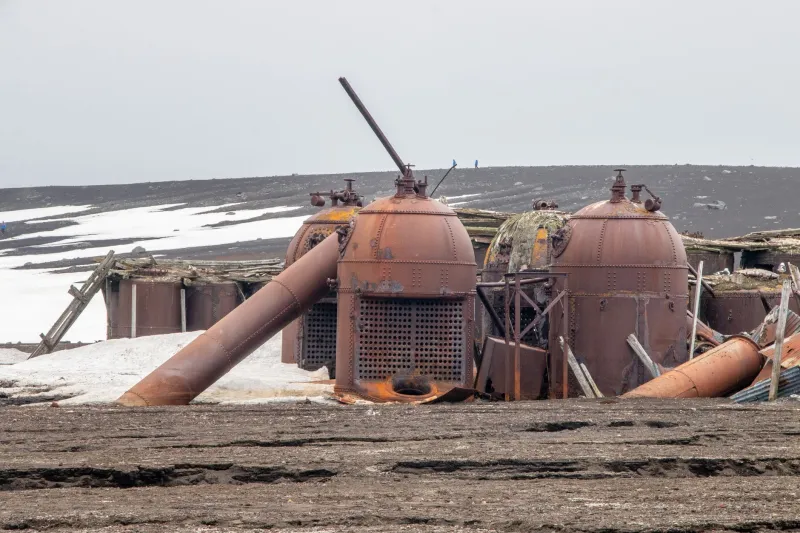
In 1960, the Soviet Union dispatched a team of researchers to Novolazarevskaya Station, a scientific outpost perched at the edge of the Antarctic continent. Rogozov, a 27-year-old surgeon from Leningrad, was the expedition's sole physician. That last detail is important. There was no backup. No second opinion. No one to call if things went sideways.
For months, the team worked through the brutal Antarctic winter, isolated from the rest of civilization in a way that's difficult to fully appreciate from the comfort of, say, a heated American living room. Resupply was seasonal. Evacuation wasn't a realistic option once the winter storms set in. The nearest hospital might as well have been on another planet.
Then, in April 1961, Rogozov began feeling sick.
At first it seemed like a passing illness — fatigue, nausea, a low-grade fever. But within days, the pain migrated to his lower right abdomen and the diagnosis became unavoidable. His appendix was inflamed and rapidly worsening. Without intervention, it would rupture. A ruptured appendix in Antarctica, with no surgical help available, was effectively a death sentence.
The Decision No Medical School Prepares You For
Rogozov had two choices: do nothing and almost certainly die within days, or attempt something that had almost no precedent in medical history. He chose the latter.
He recruited two of his fellow researchers — neither of whom had any medical training — to assist him. One held a mirror so Rogozov could see what he was doing. Another handed him instruments and monitored his condition. A third stood by in case anyone fainted. (Spoiler: the assistants came close.)
Using a local anesthetic, Rogozov numbed the surgical site as best he could, then made the first incision into his own abdomen. He worked lying at a 30-degree angle, using the mirror to navigate — though he later noted that working in reverse reflection was so disorienting he frequently had to rely on touch alone. His hands, by every account including his own, had to remain perfectly steady even as his blood pressure dropped and waves of nausea threatened to overwhelm him.
He took breaks every few minutes to rest and recover his focus. The procedure lasted roughly an hour and forty-five minutes.
He removed the appendix successfully. It had been less than 24 hours from rupture.
What It Actually Felt Like
Rogozov kept a journal throughout the expedition, and his entries from those days are among the most quietly remarkable documents in the history of medicine. He described a growing sense of detachment — a mental state where he stopped thinking of himself as the patient and forced himself to think only as the surgeon. He wrote about the strange calm that came over him once the procedure began, a focus so complete that fear seemed to recede into the background.
But he also admitted that at several points, he genuinely wasn't sure he would make it through. His assistants, by their own accounts, were terrified. At one point, one of them nearly fainted and had to be talked through continuing to hold the mirror steady.
Two weeks later, Rogozov had recovered enough to return to his normal duties at the station.
The Aftermath Nobody Expected
When the expedition returned to the Soviet Union the following year, Rogozov's story became something of a sensation — though perhaps less celebrated in the West than it deserved to be, given the Cold War context. He was awarded the Order of the Red Banner of Labour, continued his medical career, and eventually became a respected figure in Soviet and later Russian medicine.
He never made a habit of talking about what he'd done. In interviews, he tended to frame the self-surgery as simply what the situation required — a practical solution to a practical problem. That matter-of-fact quality is, in some ways, the strangest part of the story.
Because what Rogozov did wasn't just physically extraordinary. It required him to override the most fundamental instinct in surgery: the understanding that you cannot properly care for a patient when you are the patient. He had to become two people at once — the steady-handed physician and the terrified man on the table — and somehow keep both of them functional for nearly two hours.
A Question Worth Sitting With
Medical historians still discuss the Rogozov case, not just as a curiosity but as a window into what human beings are capable of when the alternative is simply not surviving. The physical feat is remarkable. The psychological one might be even more so.
Somewhere in Antarctica, in the middle of a blizzard, a 27-year-old doctor looked at the situation, decided that the odds of doing nothing were worse than the odds of cutting himself open, and picked up a scalpel.
And then he went back to work two weeks later like it was Tuesday.
History is full of acts of courage. Very few of them require you to operate on yourself with a mirror.