The Ghost in the Photo That Couldn't Have Been There — But Was
A Cemetery Nobody Visits Anymore
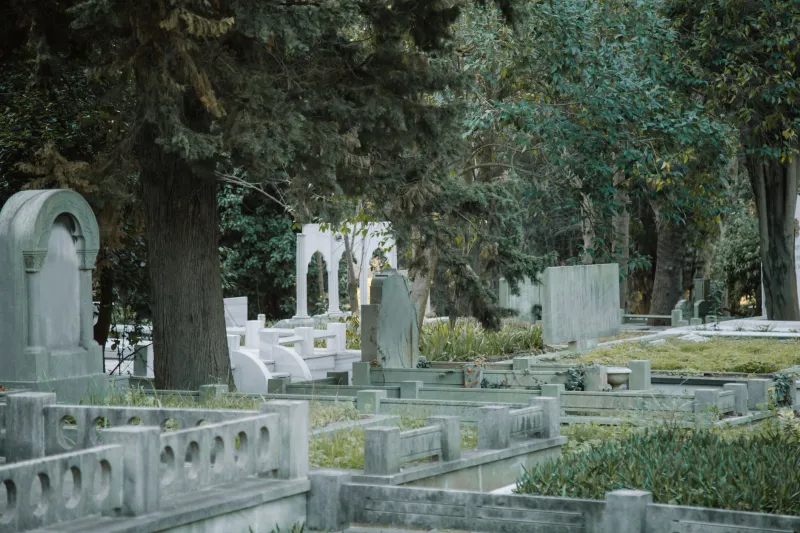
Bachelor's Grove Cemetery sits at the edge of a forest preserve in Midlothian, Illinois, about twenty miles south of Chicago. It's small, heavily overgrown, and almost completely abandoned. The last burial recorded there took place in 1989. Before that, the most recent ones dated back decades. The cemetery has no active caretaker, no regular visitors, and no particular reason to exist in the public consciousness.
Except that it does — because of a single photograph taken on August 10, 1991, that has never been fully explained.
The image shows a translucent woman, dressed in what appears to be old-fashioned clothing, sitting alone on a broken grave marker. She is not looking at the camera. She appears to be staring at something just out of frame. And according to everyone present when the shutter clicked, there was absolutely nobody there.
The Team That Took the Picture
The photograph was taken by Mari Huff, a member of the Ghost Research Society, a Chicago-based paranormal investigation group that had organized a formal research trip to Bachelor's Grove that summer. The group used infrared-sensitive film — a choice that matters, because infrared photography picks up light wavelengths the human eye can't see, which is part of why the image has been so difficult to dismiss.
Huff was using a standard 35mm camera loaded with Kodak High Speed Infrared film. She was photographing an area of the cemetery that appeared, to everyone present, to be completely empty. When the film was developed, the woman was there.
The Ghost Research Society published the image. It was picked up by paranormal researchers, then by mainstream media, then by the internet — where it has lived ever since as one of the most frequently cited pieces of alleged ghost photography in American history. It appeared in books, on television documentaries, and in countless online discussions about whether photographic evidence of the supernatural is even theoretically possible.
What the Skeptics Say
The rational explanations for the Bachelor's Grove photograph are, to be honest, not very satisfying — which is a big part of why the image has lasted this long.
The most common debunking argument is double exposure: the idea that the film captured two separate images layered on top of each other, creating the illusion of a transparent figure. This is a real phenomenon with infrared film, and it has produced some genuinely spooky-looking accidental images over the years. The problem is that when photographic analysts examined the Bachelor's Grove negative, they found no evidence of a double exposure. The image appeared to be a single, clean capture.
Another theory involves light reflection — the idea that sunlight filtering through the trees and bouncing off the headstones created a human-shaped artifact on the film. Infrared film is particularly sensitive to light and heat, so unusual visual effects are possible. But the figure in the photograph has too much structural detail — a visible dress, a seated posture, what appears to be a face in partial profile — for most analysts to accept a random light artifact as a complete explanation.
The third and most obvious explanation is a hoax: someone was sitting on that grave, and the research group either didn't see them or is lying about it. This is always on the table when paranormal evidence is involved. But the Ghost Research Society's members have maintained their account consistently for over thirty years, and no member of the group has ever come forward to admit a fabrication.
The Detail That Makes It Stranger
Here's where the story takes a turn that even committed skeptics find a little uncomfortable.
Researchers who studied the image closely noticed something that hadn't been part of the original discussion: the woman's clothing. The dress, the collar style, and what appears to be the cut of the sleeves are consistent with women's fashion from the late 19th or very early 20th century — not 1991. This could mean nothing. A person in period costume sitting in an old cemetery is an entirely plausible scenario. But it adds a layer to the image that simple light-artifact theories don't account for.
Additionally, Bachelor's Grove has a documented history that makes it an unusual location even without the photograph. The cemetery was heavily vandalized throughout the 1960s and 70s — headstones were moved, graves were disturbed, and at least one body was reportedly disinterred by vandals. Local historians have noted that the site's physical disruption is unusually severe compared to other abandoned cemeteries in the region. Whether that matters to anything is a question each reader gets to answer for themselves.
The Image That Refuses to Be Resolved
What makes the Bachelor's Grove photograph genuinely fascinating — from a purely journalistic standpoint — is that it sits in a category of evidence that's almost impossible to process cleanly. It's not an obvious fake. It's not an obvious natural phenomenon. It's not backed by enough corroborating documentation to be conclusive, but it's not so poorly documented that it can be waved away either.
Photographic technology has advanced enormously since 1991. Digital forensic analysis tools that didn't exist when Huff took her picture are now routinely used to detect manipulation, double exposure, and compositing in images. Several researchers have applied these tools to the Bachelor's Grove photograph over the years. None of them have produced a definitive finding either way.
The Ghost Research Society still exists. Bachelor's Grove Cemetery is still there, still overgrown, still occasionally visited by people who want to see if they can catch something on camera.
So far, nobody has come back with anything quite like what Mari Huff brought back in 1991. The woman on the grave — whoever or whatever she was — has not been seen again.
Which, depending on how you look at it, is either reassuring or the strangest part of the whole story.