The Most Romantic Medical Breakthrough in History
In the sterile world of 1890s surgery, love stories were rare. But hidden behind one of medicine's greatest safety innovations lies a tale of romance, chemistry, and the lengths one man would go to protect someone he cared about. Dr. William Halsted's invention of surgical gloves wasn't driven by scientific curiosity or medical necessity — it was born from watching the woman he loved suffer, day after day, in the operating room.
What started as a personal gesture to save his scrub nurse's hands accidentally became the foundation of modern surgical safety, saving millions of lives in the process.
When Medicine Was a Brutal Business
Johns Hopkins Hospital in Baltimore was at the cutting edge of American medicine in 1889, but "cutting edge" still meant something quite different than today. Surgeons operated in street clothes, washing their hands was optional, and the operating room looked more like a butcher shop than a medical facility.
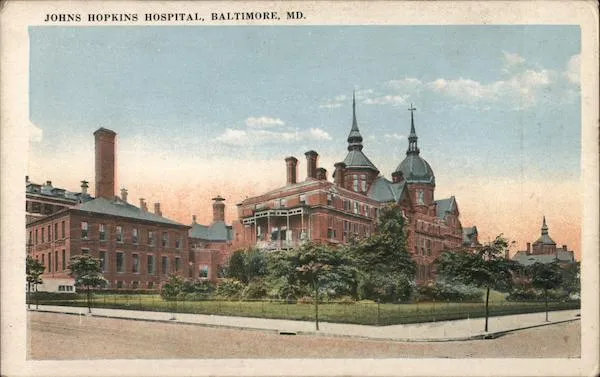 Photo: Johns Hopkins Hospital, via www.cardcow.com
The push for sterile surgery was just beginning, led by European pioneers who insisted that cleanliness could prevent the infections that killed more patients than the diseases themselves. American hospitals were slowly adopting these practices, which meant dousing everything — instruments, surfaces, and human hands — with harsh chemical solutions.
Dr. William Halsted, the hospital's chief of surgery, was a meticulous man obsessed with surgical precision. But he was also developing feelings for Caroline Hampton, the head operating room nurse whose skill and intelligence had made her indispensable to his surgical team.
The Problem with Progress
Caroline Hampton was brilliant at her job, but the new sterilization protocols were destroying her hands. The mercuric chloride solutions used to disinfect everything in the operating room caused severe dermatitis, leaving her hands cracked, bleeding, and painfully swollen.
"Her hands were so damaged that she could barely hold instruments," wrote a colleague years later. "Dr. Halsted watched her struggle every day, trying to maintain her composure while her hands were essentially being chemically burned."
The standard medical advice was simple: if you couldn't tolerate the chemicals, you couldn't work in surgery. For Hampton, this meant choosing between her career and her health. For Halsted, it meant losing both his best nurse and the woman who had captured his attention.
A Custom Solution for a Personal Problem
Rather than accept the conventional wisdom, Halsted decided to solve the problem himself. He contacted the Goodyear Rubber Company with an unusual request: could they manufacture thin rubber gloves that would protect hands from chemicals while still allowing the dexterity needed for surgical work?
This wasn't a medical experiment or a scientific hypothesis. It was a man trying to help someone he cared about continue doing the work she loved. The fact that it might revolutionize surgery was entirely beside the point.
Goodyear's engineers had never received such a request, but they were intrigued by the challenge. After several attempts, they produced thin, flexible rubber gloves that fit Hampton's hands perfectly. When she wore them in the operating room, her hands were protected from the harsh chemicals while maintaining full dexterity.
The Accidental Revolution
The gloves worked so well that other surgical staff began asking for their own pairs. Halsted, still focused on Hampton's needs rather than medical innovation, obliged by ordering more gloves from Goodyear.
It took months before anyone realized what was happening: surgical infections were dropping dramatically. Procedures that once carried high risks of post-operative complications were becoming routine. The operating room was becoming a safer place, not just for the staff, but for patients.
The connection wasn't immediately obvious. The medical establishment was focused on chemical sterilization as the key to preventing infection. The idea that thin rubber barriers could be more effective than harsh chemical solutions seemed almost too simple to be true.
Recognition Comes Slowly
It wasn't until 1894 that medical journals began publishing papers about the effectiveness of rubber gloves in preventing surgical infections. Even then, the focus was on the scientific benefits rather than the personal story behind the innovation.
Halsted himself rarely spoke publicly about his motivation for ordering the first gloves. In medical circles, he was known for his surgical innovations and his exacting standards, not for romantic gestures. The fact that his greatest contribution to medicine began as an act of love remained largely unknown for decades.
Meanwhile, Caroline Hampton continued working as his scrub nurse, her hands now protected and her career secure. In 1890, she and Halsted married, making their professional partnership permanent in more ways than one.
The Story Behind the Science
For years, medical textbooks taught that surgical gloves were developed as part of the broader movement toward sterile surgery. The official history emphasized scientific methodology and careful observation of infection rates. The personal motivation behind the invention was treated as a footnote, if it was mentioned at all.
This sanitized version of history persisted well into the 20th century. Medical students learned about Halsted's contributions to surgery without knowing that his most important innovation began with a desire to protect his future wife's hands from chemical burns.
Love's Lasting Legacy
Today, surgical gloves are so fundamental to medical practice that it's hard to imagine surgery without them. Every operation performed in sterile conditions owes a debt to Halsted's personal gesture in 1889. The billions of gloves used annually in hospitals worldwide trace their lineage back to those first custom pairs made for Caroline Hampton.
The story of surgical gloves reminds us that medical breakthroughs don't always follow the neat narrative of scientific progress. Sometimes the most important innovations come from the most human motivations: love, care, and the simple desire to protect someone from harm.
William Halsted's legacy in surgery is well-documented, but perhaps his greatest achievement was showing that the best medical innovations often begin not with grand theories, but with paying attention to the person standing right next to you.