The Colorado Ghost Town That Keeps Forgetting It Doesn't Exist
Democracy Gone Wonderfully Wrong
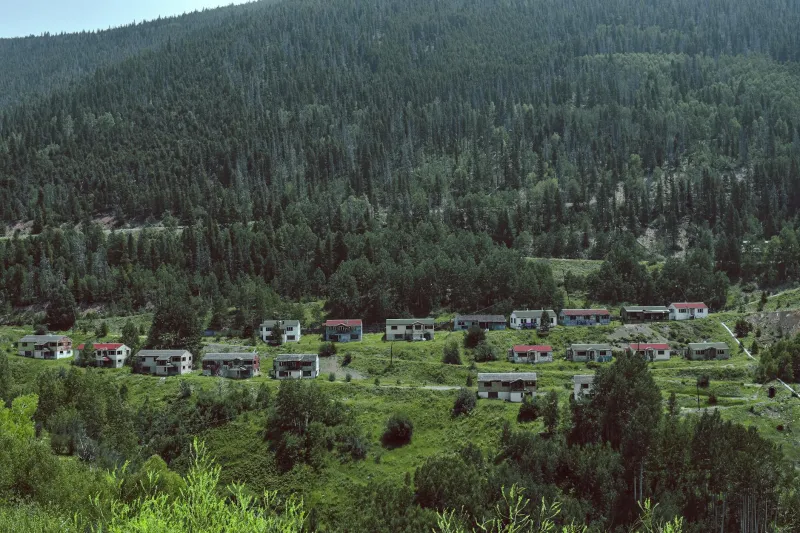
Most towns worry about losing population, declining businesses, or budget shortfalls. The town of Scenic, Colorado, has a more unique problem: it can't decide whether it wants to exist or not. Over the past century, this tiny mountain community has voted itself out of existence multiple times, only to resurrect itself when residents realize they actually need things like garbage collection and snow removal.
It's like a municipal version of Groundhog Day, except instead of Bill Murray, you have a handful of stubborn Coloradans who keep changing their minds about whether they want to deal with the paperwork of being an actual town.
The First Great Disappearing Act
Scenic's saga of existential confusion began in the early 20th century when the town was officially incorporated as a mining settlement in the Colorado Rockies. Like many boom-and-bust communities in the American West, Scenic's population fluctuated wildly based on mining fortunes and economic conditions.
By the 1960s, the town's population had dwindled to fewer than 50 residents. Maintaining municipal services for such a small population became financially impossible. The cost of running a town government, maintaining roads, and providing basic services far exceeded what the tiny tax base could support. So, in a move that would make libertarians weep with joy, the residents held a vote and decided to simply stop being a town.
The disincorporation process was surprisingly straightforward. Residents filed paperwork with the state, held the required public hearings, and officially dissolved their municipal government. Scenic ceased to exist as a legal entity, becoming an unincorporated community under county jurisdiction.
The Zombie Town Resurrection
For several years, this arrangement worked fine. The county handled basic services, and residents enjoyed the freedom from municipal taxes and regulations. But then winter arrived with a vengeance, and nobody was quite sure whose job it was to plow the roads.
Turns out, not being a town has some serious drawbacks. When your water system breaks down, there's no municipal budget to fix it. When you need a new stop sign, there's no town council to approve it. When tourists start treating your unincorporated community like their personal camping ground, there's no local authority to tell them to move along.
By the early 1980s, Scenic's residents had had enough of their experiment in municipal non-existence. They filed paperwork to reincorporate, held elections for a new town government, and officially brought Scenic back from the dead.
The Second Death and Resurrection
You'd think one round of municipal death and resurrection would be enough for any community, but Scenic's residents apparently enjoy the bureaucratic drama. In the 1990s, facing another population decline and budget crisis, they voted to disincorporate again.
This time, the dissolution lasted longer. Scenic remained legally non-existent for over a decade, with county services handling the basics and residents adapting to life without municipal government. But history has a way of repeating itself, especially in small Colorado towns with commitment issues.
In 2004, Scenic incorporated yet again, citing the same issues that had prompted their previous resurrection: inadequate county services, lack of local control, and the need for municipal authority to address community-specific problems.
The Bureaucratic Groundhog Day
Scenic isn't alone in this municipal identity crisis. Across rural America, dozens of tiny towns have engaged in similar cycles of incorporation, disincorporation, and re-incorporation. The reasons are almost always the same: small populations make municipal government expensive and complicated, but county-level services often can't address hyperlocal needs.
What makes these stories remarkable isn't just the bureaucratic absurdity—it's what they reveal about American democracy at its most granular level. These communities are essentially conducting real-time experiments in governance, testing the limits of how small a democracy can be while still functioning effectively.
The Mathematics of Micro-Democracy
Consider the logistics involved in Scenic's municipal flip-flopping. Each incorporation and disincorporation requires extensive paperwork, public hearings, state approval, and legal procedures that can take months or years to complete. For a town with a population that sometimes dips below 30 people, this represents an enormous per-capita investment in bureaucracy.
Yet residents keep going through the process, suggesting that the question of municipal existence touches something deeper than simple cost-benefit analysis. It's about local control, community identity, and the very American belief that people should have a say in how they're governed, even if they can't quite agree on what that governance should look like.
The Persistence of Place
What's fascinating about Scenic and similar communities is how they maintain their identity regardless of their official legal status. Whether incorporated or not, residents still think of themselves as living in "Scenic, Colorado." The post office still delivers mail there. GPS systems still recognize it as a destination. The town exists in every meaningful way except the legal one.
This disconnect between official existence and practical reality highlights the sometimes arbitrary nature of municipal boundaries and government structures. A place can be very real to the people who live there while being completely invisible to state bureaucracy.
Lessons from the Vanishing Town
Scenic's repeated resurrections offer insights into the challenges facing rural America in the 21st century. As populations shift toward urban centers, thousands of small communities face similar questions about the viability of local government. Some, like Scenic, choose the nuclear option of simply ceasing to exist. Others merge with neighboring municipalities or transition to special districts with limited authority.
But Scenic's story also demonstrates the resilience of community identity. No matter how many times the town votes itself out of existence, it keeps coming back. Residents may disagree about the need for municipal government, but they consistently agree that Scenic is their home—even when it technically isn't a place at all.
In the end, Scenic's saga reveals a fundamental truth about American democracy: given enough time and determination, any group of people can bureaucracy themselves into almost any situation, including accidentally making their own town disappear. The real question isn't whether they can do it—it's whether they'll remember why they wanted to in the first place.