Seven Times Lightning Chose Him—And He Lived to Tell About It
Seven Times Lightning Chose Him—And He Lived to Tell About It
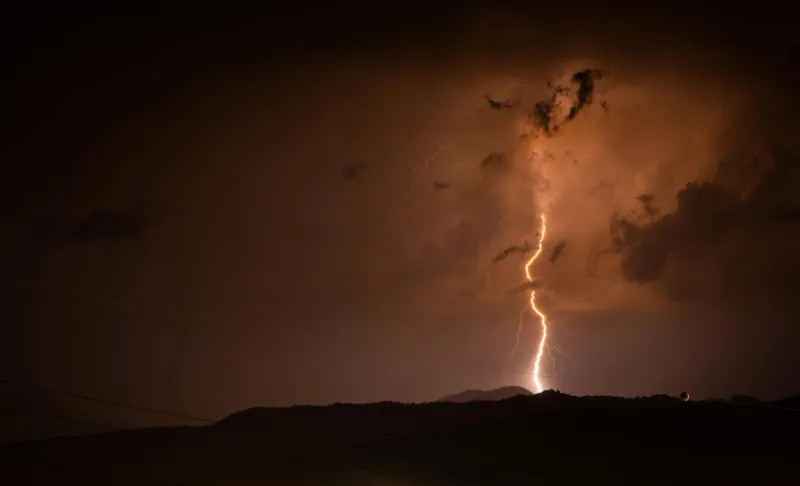
Imagine being struck by lightning. Once. Most people who experience this rare event spend years recovering—if they survive at all. Now imagine it happening seven times. Over 35 years. All documented. All verified. All survived.
This isn't the plot of a superhero origin story. This is the actual life of Roy Sullivan, a park ranger from Virginia whose name now appears in Guinness World Records under a category so specific it might as well have been created just for him: "Person Struck by Lightning the Most Times."
When you first hear this story, your brain rebels. Seven times? How is that even physically possible? The odds of being struck by lightning even once in your lifetime are roughly 1 in 500,000. The odds of surviving seven strikes across four decades? Mathematicians have essentially thrown up their hands and called it "statistically improbable to the point of absurdity."
Yet Roy Sullivan lived it.
The Unluckiest Man Alive—Or the Luckiest?
Sullivan's ordeal began in 1942, when he was working as a ranger at Shenandoah National Park in Virginia. The first strike singed his leg badly enough to hospitalize him, but he recovered. You might think he'd switch careers. Become an accountant. Move to Arizona. Do literally anything to avoid standing on top of mountains during thunderstorms.
Instead, Sullivan kept his job. And kept getting struck.
Strike number two came in 1969, nearly three decades later, burning his shoulder. By 1970, another bolt caught him while he was inside a ranger station—it entered through the roof and exited through his leg. The strikes kept coming with alarming regularity: 1972, 1973, 1976, 1989. Each time, Sullivan survived. Each time, he returned to work.
What makes Sullivan's story so genuinely strange isn't just the frequency of the strikes. It's that he became almost famous for it. Park visitors knew about the lightning ranger. News crews tracked him. Scientists studied him. By the time the seventh strike hit in 1989, Sullivan had become a minor celebrity—the man who couldn't be killed by electricity itself.
But here's where the story takes an unexpected turn.
When Luck Runs Out
Roy Sullivan died in 1994—at age 71—from a self-inflicted gunshot wound. Not from lightning. Not from complications of his injuries. From something entirely ordinary, entirely human, and entirely tragic.
He'd survived lightning seven times. He survived the statistical impossibility. He survived the burns, the cardiac arrhythmias, the neurological damage that should have killed him. But he couldn't survive whatever internal struggle was happening in his mind.
This detail transforms Sullivan's story from a simple "wow, that's wild" anecdote into something more complex and unsettling. Yes, his survival from lightning strikes was extraordinary. But his death reminds us that the body's resilience and the mind's fragility are two entirely different things.
The Science Behind the Impossible
Doctors who examined Sullivan over the years were baffled. Lightning is a violent, chaotic force. When it strikes a human body, it can cause:
- Cardiac arrest
- Severe burns (internal and external)
- Neurological damage
- Hearing loss
- Vision problems
- Permanent nerve damage
Most people struck by lightning once suffer long-term complications. Some don't survive at all. Sullivan endured all of this seven times.
One theory suggests that Sullivan's repeated exposure somehow made his body more resistant—a horrifying form of accidental conditioning. Another points to pure luck: the angle of each strike, the ground conductivity, the clothing he wore, the exact milliseconds of timing. Probability is a fickle master, and sometimes it just decides you're going to be the exception to every rule.
Lightning researchers still study Sullivan's case. His medical records are part of the permanent record in the study of electrical injuries. But no definitive explanation has ever emerged. He remains an outlier, an anomaly, a walking violation of statistical certainty.
The Question We Can't Answer
Here's what makes Roy Sullivan's story fit perfectly into the "Quirk of History" universe: it's a story that sounds completely fabricated, yet every detail is verifiable. You can look up his name. You can read his medical records. You can confirm he was indeed struck by lightning seven times.
But you still can't quite believe it.
Was Sullivan the unluckiest man alive—doomed by geography and occupation to repeatedly encounter the one force that should have killed him? Or was he the luckiest, blessed with a body and constitution so improbable that it defied the laws of probability itself?
Maybe he was both. Maybe that's the real quirk—not that Sullivan survived lightning strikes, but that surviving them didn't save him from everything else life had to throw at him. Sometimes the most improbable survival story is also the saddest one.